

For TemperPack, the sustainable packaging manufacturer reducing waste across industries, protecting products and the planet is more than a tagline. In addition to the sustainability attributes of the products, the company’s ethos challenges the status quo of packaging manufacturing by investing in efficiencies and business behaviors with lower environmental impact.
As a high-growth manufacturer having doubled its employee count since 2020, TemperPack wanted to ensure that they would continue to be a leader in sustainability as their business scales. To do so, they needed to identify practical ways to balance sustainability with increased production.
For a company built on sustainability, the risk of greenwashing is existential. Setting unrealistic goals could undermine the brand’s credibility, erode investor confidence, and threaten long-term growth.
As a mission-driven company, TemperPack needed a way to decarbonize operations through practical, growth-aligned actions without requiring massive technology overhauls.
Rappel’s hybrid technology-and-service model combined scalability with flexibility, helping TemperPack efficiently pinpoint operational levers that could deliver real emissions and cost reductions all while using the systems and data infrastructure they already had in place.
“As a lean Sustainability team, we needed a decarbonization partner who could connect directly with our engineers to understand our manufacturing process quickly and effectively. Rappel served as an extension of our sustainability team as subject matter experts on all things carbon, from methodology to targets.”
— Liz Helm, Sustainability Senior Manager
With Rappel, TemperPack gained actionable data, expert guidance, and internal alignment needed to move from broad sustainability intent to detailed decarbonization roadmap.
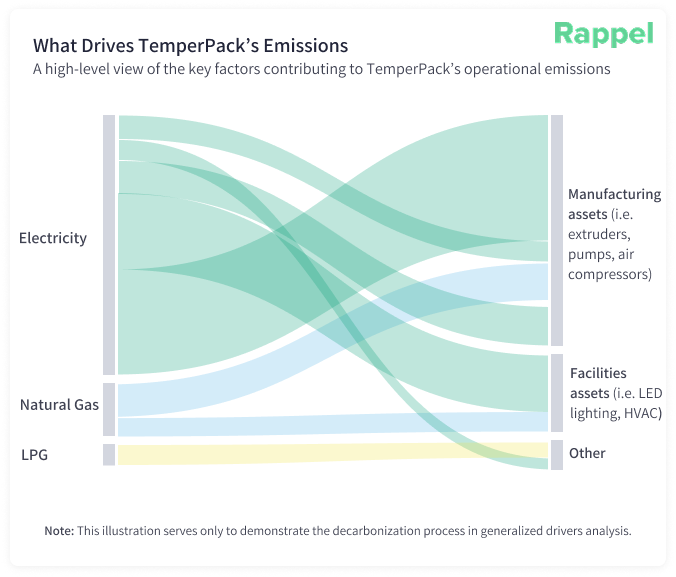
To accurately capture TemperPack’s unique manufacturing process and ensure high-quality data for decarbonization planning, Rappel started with a virtual walkthrough of TemperPack’s three largest facilities, which together produce over 90% of the company’s operational emissions.
Unlike a traditional, on-site engineering walkthrough, Rappel’s streamlined virtual approach maximizes value while minimizing the time required from busy facility teams. The virtual walkthrough process resulted in knowing the emissions and cost associated with each asset and piece of equipment that TemperPack operates, replacing assumptions with tangible data.
With drivers of emissions identified, Rappel modeled decarbonization levers and worked with TemperPack’s engineering leads to validate assumptions and feasibility. Through this work, Rappel pinpointed the actionable opportunity to increase manufacturing energy efficiency by 15% through a select set of actions and save 67% of TemperPack’s rental AC costs.
Rappel engaged TemperPack leadership from the start to align around a decarbonization vision. Through early engagement with cross-functional executives, Rappel built trust and ensured the process reflected TemperPack’s operational realities and growth ambitions.
Rappel modeled multiple decarbonization pathways -- including cost-saving, business-as-usual, Science Based Targets (SBT)-aligned, and custom scenarios -- to illustrate trade-offs between ambition, cost, and feasibility. Together, Rappel and TemperPack explored the challenge of setting an absolute emissions target as a fast-growing business. Recognizing the SBTi’s current limitations for companies with rapid growth trajectories, TemperPack ultimately developed an internal intensity target that balanced expansion with carbon reduction objectives.
The modeling combined near-term, low-cost opportunities with longer-term investments, evaluated based on implementation timing, business impact, and ease of execution. By the end of the engagement, TemperPack had a clear, actionable roadmap with defined owners and governance structures that positioned the company to advance confidently along its decarbonization journey. TemperPack has already been discussing to incorporate efficiency improvements, from evaporative cooling to air compressor improvements, into their 2026 roadmap.
Through its work with Rappel, TemperPack was able to build an actionable roadmap balancing their sustainability ambition and rapid business growth.
The company’s decarbonization roadmap details which GHG reduction solutions take priority, how they should be implemented, and who is in charge to take the actions forward. Together, the selected reduction initiatives demonstrate that meaningful decarbonization can be both financially rational and operationally achievable.
The project also created a new shared language around decarbonization and emissions efficiency inside TemperPack where cross-functional teams, from engineering to executive leaders, are actively involved in decarbonization actions and decisions.
“Embedding decarbonization into manufacturing isn’t just about emissions - it’s about making better operational decisions.”
— Temper Pack’s VP of Engineering
With its decarbonization roadmap and support from Rappel, TemperPack is able to uphold its climate focus without greenwashing and form a strategic edge with investors and major customers aiming to cut supply chain emissions and achieve their own decarbonization goals.
Rappel continues to provide quarterly strategic guidance and implementation support, helping TemperPack sustain progress and expand its impact. The two teams are now turning their focus to Scope 3 emissions to identify opportunities across the value chain.