

25%
estimated emissions intensity reduction by 2030
>$730K
in identified annual savings by 2030
The State Group (TSG) is one of North America's leading multi-trade industrial and specialty services contractors, serving Fortune 100 manufacturers, utilities, and highly technical industrial partners since 1961.
When Apollo-managed funds acquired a majority stake in TSG in 2024 to support continued growth, TSG committed to advancing financially material sustainability priorities, including managing its carbon footprint.
With fragmented operational data following rapid growth and acquisitions, TSG needed a partner who could quickly bring the team up to speed while working within its limited time and resources.
TSG consequently engaged Rappel as a trusted partner with a proven track record of developing measurable, value-accretive decarbonization strategies from the ground up.
Rappel supported TSG using its proprietary carbon management approach, combining scaled data analytics with direct expert support.
Working together, TSG established an emissions baseline, identified financially material decarbonization opportunities, and translated the analysis into a practical implementation aligned with the company’s growth plans.
The first challenge was organizing TSG’s fragmented operational data. Rappel built an Inventory Management Plan (IMP) with TSG through a single working session, mapping emissions-generating activities and their data sources to create a foundation for measuring greenhouse gas (GHG) emissions.
Rather than filling out endless data templates, TSG gathered energy and asset data in the formats they already used. They then utilized Rappel’s Carbon-Optimized Asset Investment Model (CO₂-AIM) analytics suite, including an AI utility bill reader, to automatically process and validate TSG’s data for emissions measurement.
Within weeks, TSG gained clear visibility into its GHG emissions, fuel use, and energy spending at the asset level, establishing a reliable foundation for decarbonization planning.

TSG’s emissions inventory confirmed that >80% of the company’s operational emissions were generated by its fleet of 1,000+ vehicles. The second challenge became clear: what options existed to manage vehicles without increasing costs or hindering growth?
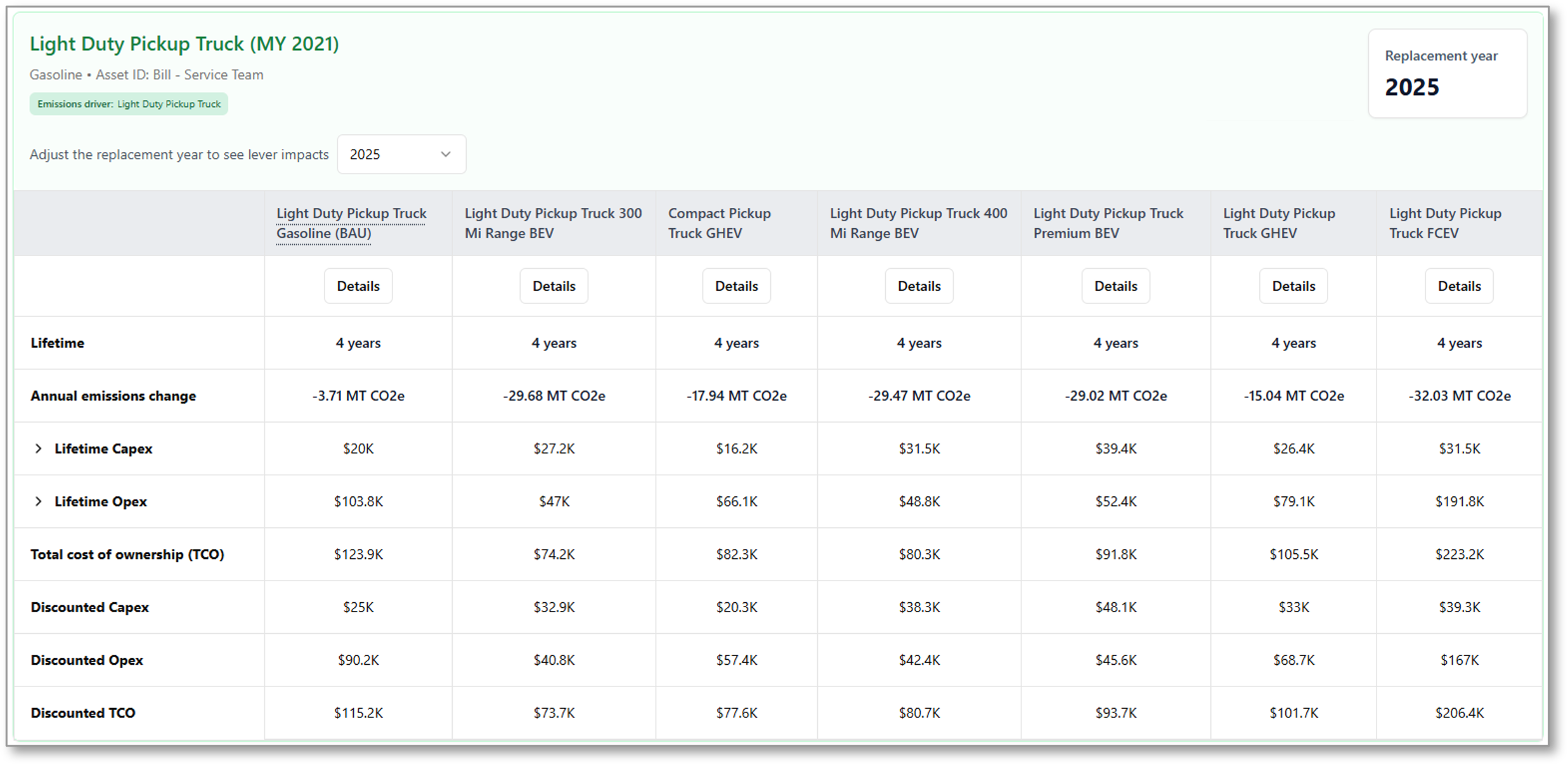
Using Rappel’s CO₂-AIM reduction lever analysis tool, TSG rapidly evaluated the carbon and financial impacts of fleet decarbonization options, including downsizing, hybridization, electrification, and idle reduction technologies.
CO₂-AIM evaluated the specific business case (Capex, Opex, and total operating cost) for each vehicle in TSG’s fleet, tailoring each cash flow analysis to the vehicle’s location, usage patterns, operating costs, and expected lifetime.
Illustrative figures do not reflect TSG’s actual data due to confidentiality.
Rather than receiving a high-level marginal abatement cost curve (MACC), TSG gained a detailed view of how thousands of potential decarbonization actions would impact the business.
TSG then used the CO₂-AIM scenario optimization module to prioritize thousands of potential actions into decarbonization pathways to achieve critical strategic objectives, including cost savings, emissions reductions, and operational feasibility.

TSG then used the CO₂-AIM scenario optimization module to prioritize thousands of potential actions into decarbonization pathways to achieve critical strategic objectives, including cost savings, emissions reductions, and operational feasibility.
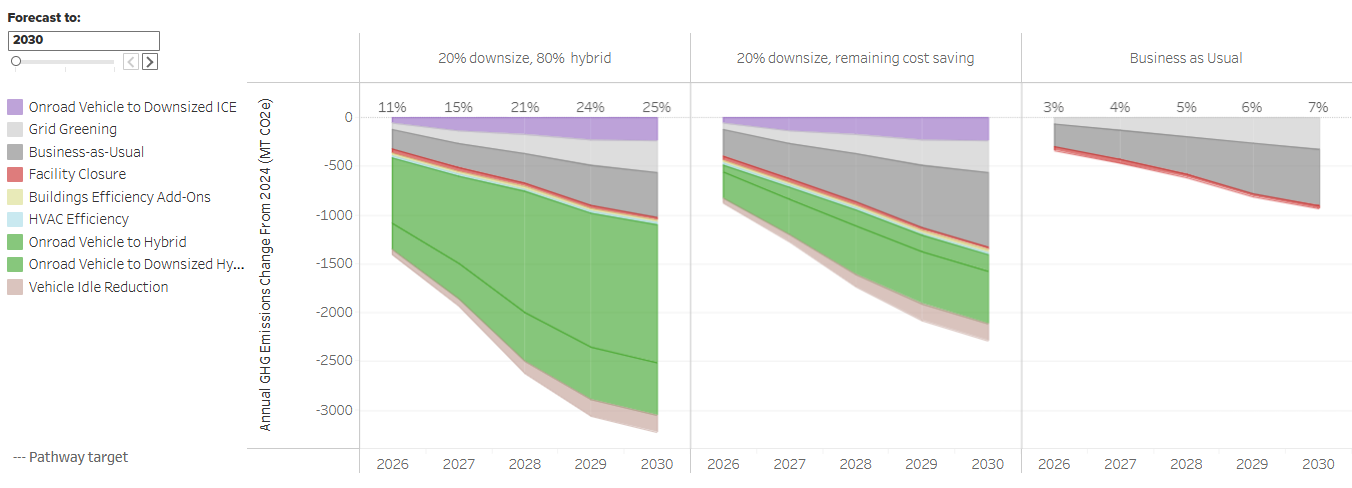
Although the analysis is traditionally a manual and time-intensive exercise, TSG completed it within weeks to support cross-functional decision-making.
With defined emissions pathways in place, TSG’s final step was to translate the analysis into an actionable roadmap.
After reviewing clear data on the carbon and financial impact of each option, the TSG leadership team developed a strategy to prioritize fleet hybridization and downsizing. The roadmap supports the company’s high-growth trajectory and is projected to deliver more than $730K in annual savings and a 25% reduction in emissions intensity by 2030.
Following completion of the roadmap in December 2025, TSG has already begun implementing its fleet downsizing and hybridization strategy, starting with operational realignment of the Canadian fleet.
In six months, TSG went from developing a comprehensive emissions inventory to implementing a fully operational decarbonization plan without adding headcounts or exceeding existing budgets.
As a long-term partner, Rappel continues to support TSG with implementation and refine the roadmap as market conditions and business priorities evolve.