
.jpg)
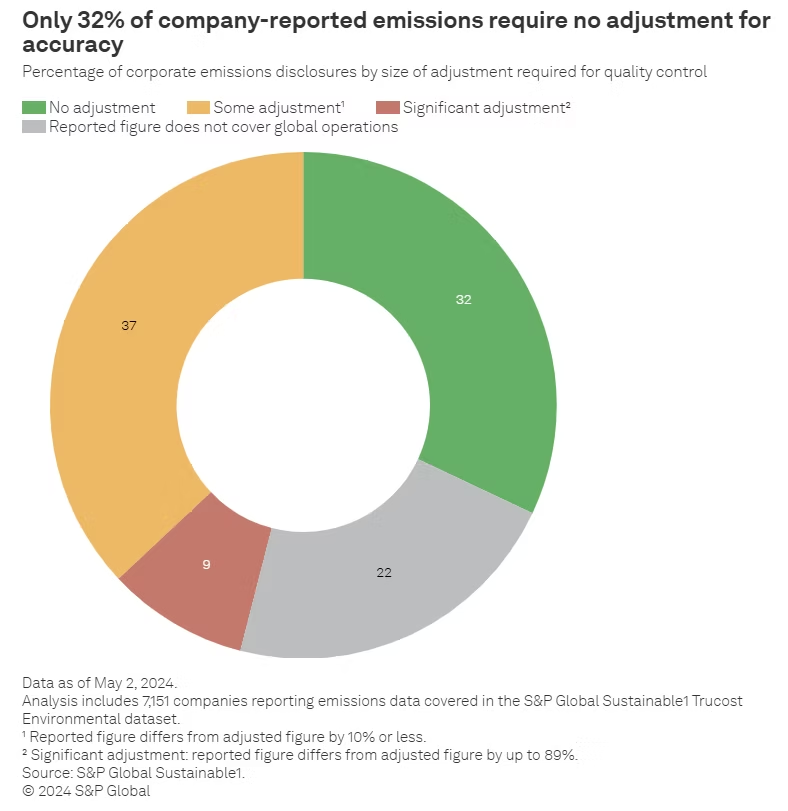
According to S&P Global's analysis of 7,151 companies, only 32% of company-reported emissions figures required no adjustment for accuracy.
At Rappel, we experience this challenge firsthand.
In fact, more than 80% of the non-Rappel inventories we review need material correction before they can support decarbonization planning.
Lean sustainability teams with limited resources tend to focus on covering the GHG Protocol requirements: emissions factors, scope labels, and potentially assurance readiness.
But this approach often overlooks the process of ensuring that emissions data accurately reflects a company’s business reality: how energy and other inputs are used across sites, fleets, and operations.
Without this reality check, it is easy to miss emissions sources, use low fidelity or inaccurate data inputs, and apply generalized emissions factors.
When emissions inventories aren’t grounded in real operating patterns, businesses miss out on the opportunity to uncover new operational insights, maintain inventory consistency year-over-year, build credibility with customers and investors, and unlock savings through decarbonization.
Validating emissions data can give operations teams new insights into asset usage and often exposes data gaps that would otherwise go unnoticed, creating improved resource management.
By clearly defining standard assumptions and methodologies, an accurate emissions inventory reduces year-to-year variation and becomes repeatable.
A solid foundation allows sustainability teams to maintain and update inventories more efficiently to reflect actual changes to a business' emissions.
Investors and customers are increasingly demanding credible sustainability commitments: 88% of institutional investors report increasing their use of ESG information, and 41% of companies engage suppliers on emissions and climate.
Starting from an accurate baseline strengthens credibility as assurance expectations rise and scrutiny shifts to tangible action.
An accurate energy and emissions baseline is critical for effective decarbonization planning, which can unlock 10–20% energy cost savings on average.
Without it, the analysis can steer teams toward the wrong priorities.
An accurate emissions inventory captures all material emissions sources, reflects real operational usage, and applies site-specific emissions factors.
Starting with an Inventory Management Plan (IMP) that clearly defines organizational boundaries, material categories and assets, and data sources reduces the risk of missing critical fuel or assets data and enables a repeatable inventory year over year.
Building from utility bills and fuel records, validating estimates with operations, and cross-checking outliers to catch errors before they skew results ensure the inventory matches how your business actually runs.
Incomplete data coverage is normal in emissions inventories, especially in early years. Gap filling should be tied to available data and operational realities, rather than generic averages, to avoid volatility and skew as data quality improves.
Most carbon accounting tools jump straight to calculations without establishing transparent foundations or validating emissions data against real operations.
At Rappel, we build emission inventories with accuracy and decarbonization readiness in mind:
We map your assets and data sources through a streamlined operations survey, then use that input to build an Inventory Management Plan that clearly defines the methodologies and boundaries for your emissions inventory.
Rappel’s proprietary analytics engine, CO2-AIM, uses advanced models and available site-level data to test energy inputs for common errors: incorrect data, gaps in coverage, and misallocated estimations.
CO2-AIM applies the GHG Protocol hierarchy for electricity emissions factors and automatically matches each account to the most granular factor available, including utility-specific factors. Additionally, CO2-AIM uses AI-based utility bill reading to identify renewable power contracts, green tariffs, and utility programs so emissions factors reflect contracted electricity rather than assumed grid mix.
Rappel integrates with your existing data infrastructure so you can move faster without extra work.
Along the way, a dedicated delivery manager helps your team master the fundamentals of GHG inventories and apply best-practice data sources, methods, and processes.